
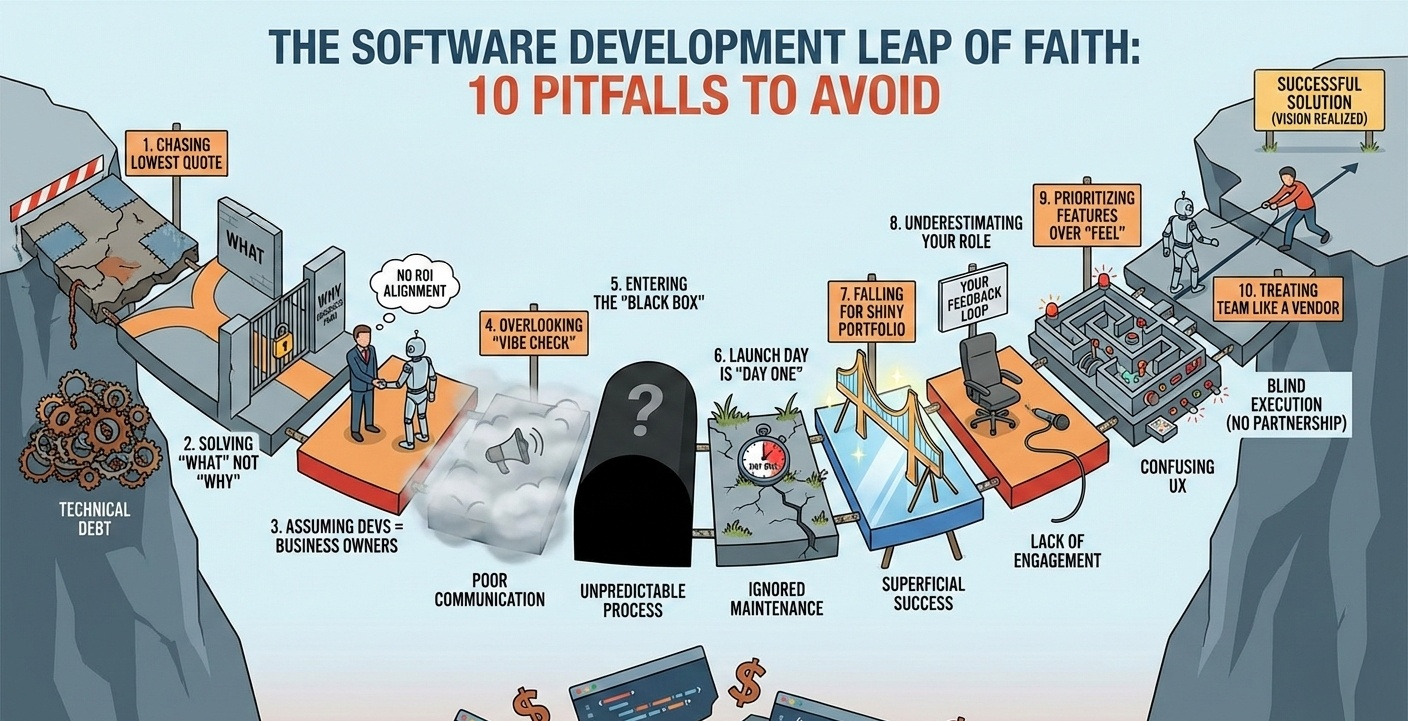
Buying software development services is a massive leap of faith. You’re handing over your “baby”—and a significant chunk of your budget—to a team you hope understands your vision.
At Entangle Software, we’ve sat across the table from hundreds of founders. We’ve seen that knot-in-the-stomach feeling firsthand. Most software project failures don’t happen because of bad code; they happen because of human disconnects that occur before the first line of code is ever written.
If you want to protect your investment and ensure your custom software solution actually works, avoid these 10 common pitfalls.
1. Chasing the Lowest Quote
(The “Cheap Is Expensive” Paradox)
It’s tempting to treat web development like a commodity—just pick the lowest price. But choosing the cheapest bidder often leads to technical debt: messy code that costs more to fix later than it did to build.
The Pro Move:
Look at Total Cost of Ownership. A slightly higher upfront investment in clean, scalable code can save thousands in maintenance over the next three years.
2. Solving the “What” Instead of the “Why”
We often hear: “I need an app that does X.”
But the real question is: What business pain is X supposed to solve?
Without clarity, you may end up with a beautiful product that doesn’t increase sales or save time.
The Pro Move:
Start with outcomes.
Instead of “I need an app,” say:
“I want to reduce customer support calls by 30%.”
3. Assuming All Developers Think Like Business Owners
A great coder can build a rocket ship—but may not know where it should land. Many clients expect developers to automatically understand ROI goals.
The Pro Move:
Choose a partner who asks about revenue models and user acquisition before asking about the tech stack.
4. Overlooking the “Vibe Check”
(Communication Style)
Technical skills are the baseline. Communication is the ceiling.
If a team takes three days to reply during sales, imagine launch day with a critical bug.
The Pro Move:
Notice how they explain complex ideas.
If they hide behind jargon, they’re probably hiding a lack of clarity.
5. Entering the “Black Box”
(Lack of Process)
If a developer says, “See you in three months with the finished product,” — run.
The Pro Move:
Insist on Agile or iterative development. You should see working software every 2–4 weeks.
6. Forgetting That Launch Day Is Actually Day One
Software is a living thing. It needs:
- Security patches
- Browser updates
- User-driven improvements
The Pro Move:
Reserve 15–20% of your build budget annually for post-launch support and maintenance.
7. Falling for a Shiny Portfolio Without Context
A pretty screenshot doesn’t tell you:
- If the site scaled
- If it was easy to manage
- If it survived traffic spikes
The Pro Move:
Ask for a mini case study:
“What was the biggest challenge, and how did you solve it?”
8. Underestimating Your Role in the Equation
Software development is not set it and forget it. The best products come from tight feedback loops.
The Pro Move:
Make time for regular check-ins.
Your feedback keeps the project aligned with real business goals.
9. Prioritizing Features Over Feel
(User Experience)
Software can be technically perfect and still fail if users feel confused.
The Pro Move:
Invest in UX design before development.
It’s far cheaper to move a button in a design file than rewrite production code.
10. Treating the Team Like a Vendor, Not a Partner
A vendor does what they’re told—even if it’s a bad idea.
A true partner will say “No” when something won’t help your business.
The Pro Move:
Value the No.
A developer who challenges assumptions is protecting your money and sanity.
How Entangle Software Changes the Narrative
We know you don’t want to manage technology—you just want things to work.
Here’s how we make development feel less intimidating:
Jargon-Free Zone
We talk goals, users, and growth—not buzzwords.Strategic Listening
We understand your business before writing a single line of code.Radical Transparency
You always know what we’re working on and why.Built for the Long Haul
We don’t just hand over the keys—we ride along with you.
Final Thought
The smartest software decision isn’t about the tech.
It’s about trust.
When you find a team that cares as much about your why as you do, the how becomes easy.